


October 14th
Saint Callistus I. pope
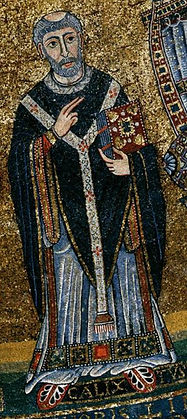
Saint Callistus I (also known as Callistus I) was Pope of the Catholic Church from approximately 217 to 222. He is venerated as a saint and martyr, and his feast day in the liturgical calendar falls on 14 October.
1. Early life and slavery
Before his election as Pope, Callistus led a turbulent life. He was born in Rome as a slave in the service of a Christian named Carpophorus.His master entrusted him with a considerable sum of money to set up a bank. The bank accepted a number of deposits and granted loans to Roman Jews, who refused to repay them. Consequently, the bank eventually went bankrupt. Callistus was arrested, but his Christian master took pity on him and arranged for his release. Once Callistus had settled his financial affairs, he went to the synagogue on the Sabbath. However, the local Jews had him arrested again on the charge that he was disrupting their services and he was sent to perform hard labour in the mines of Sardinia (known as the ‘metalla’), where conditions were exceptionally harsh. He was later released thanks to an amnesty negotiated by Pope Zephyrinus through the intercession of influential Christians at the imperial court.
2. Pontificate (c. 217–222)
Following the death of Pope Zephyrinus in 217, Callixtus was elected as his successor. However, his election sparked a serious internal conflict within the Roman Church.
● The Schism of Hippolytus: The learned priest Hippolytus opposed Callixtus, accusing him of excessive leniency and the introduction of innovations. Hippolytus had himself proclaimed Pope. This is the first historically documented schism (split) in the history of the papacy. (Despite this conflict, the two men later reconciled and died as martyrs).
● Pastoral care and mercy: Callixtus drew criticism from rigorous circles (such as Tertullian and the aforementioned Hippolytus), particularly for showing great mercy towards sinners. He taught that the Church is like Noah’s Ark, in which there are both clean and unclean animals – that is, a gathering of sinners who repent. He permitted the forgiveness of grave sins (including adultery and murder) following appropriate penance, and recognised the validity of marriages contracted between free people and slaves (which Roman law had not previously recognised).
● Catacombs: Callixtus established the official cemetery of the Roman Church on the Appian Way, which today bears his name – the Catacombs of Saint Callixtus. The complex also included the papal crypt.
3. Martyrdom
Callixtus died a martyr’s death around the year 222 during the persecution under the reign of Emperor Alexander Severus (or during a popular uprising in Rome, when he was thrown from a window into a well). His remains were later laid to rest in the Calepodius cemetery on the Via Aurelia.
Although his life was marked by struggles and fierce theological disputes, Saint Callixtus I left a profound legacy, particularly in the fields of canon law and pastoral charity. He demonstrated that the Church of Christ is open to anyone who sincerely seeks the path to repentance and reconciliation with God.
Sayings, quotations and thoughts associated with Saint Callixtus I
Although no extensive literary works by Pope Callixtus I himself have survived from the 3rd century, his ideas, pastoral approach and attitudes are documented in detail in historical sources (particularly by his critics, such as Saint Hippolytus and Tertullian), as well as in ancient Church tradition.
The following themes and ideas characterise his spiritual legacy:
1. On mercy and the Church as a refuge for sinners
Callistus’s most significant theological and pastoral contribution was his emphasis on God’s mercy towards sinners who sincerely repent. In contrast to the strict rigourism of his time, he championed the principle that the Church is not an exclusive club for the perfect, but a field hospital for
the wounded.
‘The Church is like Noah’s Ark – it contains both clean and unclean animals, because it is
a place of healing for everyone who longs for reconciliation with God.’
“If a sinner sincerely repents, does penance and turns away from his evil ways, the gate of God’s
forgiveness and reconciliation with the Church must never be closed to him.”
2. On equality before God in the sacrament of marriage
Calixt brought about a major breakthrough in the social order of his time when he recognised the ecclesiastical validity
of marriages between free Christians and slaves (Roman civil law had hitherto
prohibited this and deemed such marriages invalid). His thinking was rooted in a profound Christian
sense of equality:
‘In the sight of the Creator of life and within the bosom of the Holy Church, there is no distinction between a free person and
a slave; Christ’s love unites hearts regardless of worldly status.’
3. On suffering and faithfulness to the end
His life’s journey – from slavery and forced labour in the harsh Sardinian mines to papal
ministry sealed by martyrdom – bore witness to an unshakeable trust in God:
“Those who have experienced condemnation, slavery and the pain of the world understand more deeply the redemptive power of Christ’s cross and
the mercy that lifts up the fallen.”