


October 9th
Saint John Henry Newman
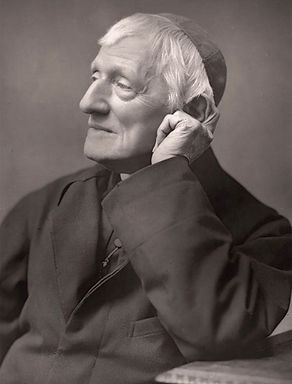
1. Childhood and Youth in England (1801–1816)
John Henry Newman was born on February 21st 1801 in London, the eldest of six children of the banker John Newman and his wife Jemima. He grew up in an environment of traditional Anglican piety of a moderate nature.
● Even as a boy, he showed an extraordinary love of books and a deep inner life.
● At the age of 15, he had a profound spiritual experience, which he later described as his first true experience of conversion and the presence of God. It was then that the conviction of the real working of God’s guidance in his life became firmly rooted within him.
2. Studies and Ministry at Oxford (1816–1845)
In 1817, he entered Trinity College, Oxford. A few years later, he became a fellow of the prestigious Oriel College, and in 1824 he was ordained as an Anglican priest.
● Academic and pastoral work: He served as a respected university preacher at St Mary’s Church. His sermons attracted both students and intellectuals with their profound spiritual depth, brilliant style and emphasis on conscience and moral integrity.
● The Oxford Movement (Tractarianism): In 1833, together with other theologians, he was instrumental in the founding of a movement that sought to revitalise the Church of England. They drew attention to its Catholic roots, apostolic succession and the need for independence from secular power. They published a series of influential writings entitled *Tracts for the Times*.
● Crisis and the search for truth: However, whilst studying the Church Fathers and the history of early Christianity in depth, Newman came across a parallel between the schisms of antiquity and the contemporary position of Anglicanism. He realised that the Anglican Church had strayed from full unity with the universal apostolic tradition.
3. Conversion and the Catholic Period (1845–1890)
In 1843, he resigned from his priestly post in Oxford and withdrew to a secluded life at Littlemore, where he spent months in prayer and fasting.
● Entry into the Catholic Church: On 9 October 1845, he was solemnly received into the Catholic Church by Blessed Dominic Barberi, an Italian Passionist priest. This conversion caused a huge stir in English society and meant that Newman lost many of his former friends and academic connections.
● Priestly ministry in Rome and Ireland: In 1846, he was ordained a Catholic priest in Rome and joined the Oratory of St Philip Neri, which he later founded himself in Edgbaston (Birmingham), England. In the 1850s, he served in Dublin as the first rector of the newly established Catholic University of Ireland.
● The struggle for truth and the *Apologia*: He faced many misunderstandings from traditional Anglicans, as well as suspicion from some conservative Catholics. In 1864, he published his autobiography, *Apologia Pro Vita Sua*, in which he convincingly and openly defended the purity of his conscience and spiritual journey, thereby earning the admiration and respect of the wider British public.
4. The Cardinal’s Hat and Death
● Appointment as a cardinal: In 1879, Pope Leo XIII – in recognition of his lifelong contribution to the Church and to theology – appointed him a cardinal, even though he was not a bishop. His cardinal’s motto was Cor ad cor loquitur (‘Heart speaks to heart’).
● Death: He died on August 11th 1890 in Edgbaston, Birmingham, aged 89.
5. The Path to Sainthood
● Beatification: Pope Benedict XVI personally declared him Blessed on 19 September 2010 during his visit to the United Kingdom. Benedict XVI frequently praised him as a teacher of conscience, fidelity to the truth and the harmonious integration of faith and reason.
● Canonisation: Pope Francis officially canonised him on 13 October 2019 and numbered him among the saints of the Catholic Church.
● Doctor of the Church: Pope Leo XIV declared him a Doctor of the Church on 1 November 2025.
6. A selection of his most inspiring thoughts and quotations:
On conscience and the voice of God
“Conscience is God’s original vicar.”
Thought: Newman viewed conscience not as a subjective creation of man, but as a sacred inner voice through which God Himself speaks to us. A person is willing to suffer for the sake of fidelity to conscience, for it is the highest moral standard.
On vocation and life’s mission
“God created me to carry out a specific work. He has entrusted me with a task which He has not entrusted to anyone else. I have my place in God’s plans... Therefore, I shall have His trust, wherever I may be.”
Thought: This well-known passage from his meditations reminds us that every human life has a unique and irreplaceable purpose.
On growth and change
“To grow is to change, and to be perfect is to change frequently.”
Thought: With this sentence, Newman expresses that true faith and personal growth are not static. The spiritual life requires openness to deeper understanding and the gradual transformation of the heart.
On faith and reason
“A thousand objections do not amount to a single doubt.”
Thought: A person may face many questions, intellectual difficulties or sceptical arguments, but this in itself need not mean the loss of a deep, living faith rooted in trust in God.
On daily life with God
“Show me what I am to do, and help me to do it.”
Thought: A simple yet profound prayer of surrender, expressing a person’s willingness to cooperate with God’s grace at every moment of the day.
The Most Famous Prayer
Lead, Kindly Light
Lead me, Kindly Light, through the darkness that surrounds me; lead me! The night is dark and I am far from home; lead me! Guard my steps; I do not ask to see the distant horizon – one step is enough for me.”
He wrote this song at a time of deep crisis and ill health, whilst he was searching for the right path.
.