


October 15th
Saint Teresa of Avila
Teresa of Jesus
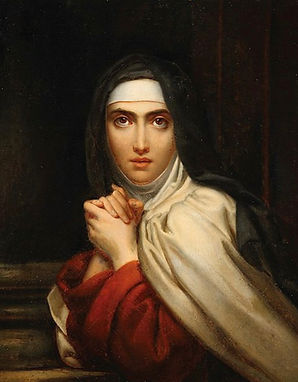
Saint Teresa of Ávila, a distinguished teacher of the Church, a nun, a mystic and a reformer of the Carmelite Order, is one of the most significant figures in the spiritual history of the Catholic Church.
1. Childhood and youth (1515–1535)
● Birth: Teresa Sánchez de Cepeda y Ahumada was born on 28 March 1515 in Ávila, Spain, into a devout noble family.
● Deep piety: Even as a child, she showed a great longing for martyrdom and eternity. Together with her brother, she once secretly set out for a region inhabited by Muslims with the intention of undergoing martyrdom for the faith, but her uncle soon found them and brought them back home.
● The loss of her mother and adolescence: Following the untimely death of her mother, when Teresa was only 12 years old, she went through a period of adolescence marked by an appreciation of worldly beauty, reading chivalric romances and concerns about her own identity. Her father therefore entrusted her to the care of the Augustinian nuns.
2. Entry into the convent and an inner crisis (1535–1555)
● Religious vocation: In 1535, she secretly left home and entered the Carmelite convent of the Suffering of the Virgin Mary of Mount Carmel in Ávila.
● Health problems: Shortly after taking her religious vows, she fell seriously ill (suffering from malaria and severe convulsions), which confined her to bed for several years and left her partially paralysed.
● Spiritual lukewarmness: In the convent at that time, there was a great deal of freedom, visits from lay guests and a comfortable lifestyle. Teresa spent almost two decades in a state of inner conflict between prayer and worldly distractions.
3. Conversion and the mystical journey (around 1555)
● The decisive turning point: Around 1555, at the age of 40, whilst gazing at a statue of the scourged Christ (‘Ecce Homo’), she experienced a moment that awakened in her a profound sense of remorse and a longing for total fidelity to God.
● Mystical experiences: She began to experience profound mystical states, interior prayers and visions. Her experience of transverberation (the piercing of her heart
by an angel) is well known; it expressed the immense fire of divine love in her soul.
4. The work of reform and the founding of the Discalced Carmelites
● A desire for renewal: Teresa recognised the need for the Carmelite Order to return to its original strict poverty, strict silence, solitude and prayer.
● The first convent (1562): Amidst great difficulties, misunderstanding and opposition from both secular and ecclesiastical authorities, she founded the small Convent of St Joseph in Ávila, where she introduced stricter monastic rules. It was from here that the branch known as the Discalced Carmelites emerged.
● Travels and Foundations: Despite her failing health, she travelled throughout Spain to found a total of 17 convents for women and, together with St John of the Cross, monasteries for the male branch (the Discalced Carmelites).
5. Literary works
Teresa was not only a great mystic, but also a brilliant writer and poet, whose works rank among the finest in Spanish literature:
● The Book of My Life (Libro de la vida): An autobiography chronicling her spiritual development.
● The Way of Perfection (Camino de perfección): A guide to prayer for her fellow nuns.
● The Interior Castle (El castillo interior): A masterpiece of mystical theology describing the seven mansions of the human soul on its journey towards God.
● The Book of Foundations (Libro de las fundaciones).
6. Death
● She died on 4 October 1582 in the town of Alba de Tormes whilst on one of her journeys.
Her last words were: ‘My Lord, it is time for us to meet.’
7. Legacy and veneration
● Canonisation: She was declared a saint by Pope Gregory XV in 1622.
● Doctor of the Church: Pope Paul VI conferred upon her the title of Doctor of the Church in 1970 (she was the first woman in history to receive this title).
● Attributes: She is depicted in the habit of the Carmelites, with a quill and a book (as a writer), with a dove (symbol of the Holy Spirit) or with a burning heart pierced by an arrow.
“My heart is restless until it rests in You.” (A thought inspired by St Augustine, which resonates deeply with Teresa’s teaching on prayer as a friendly conversation with God).
8. The Interior Castle
The work *The Interior Castle* (written in 1577) is regarded as the pinnacle of mystical theology and the spiritual life. In it, St Teresa of Ávila likens the human soul to a diamond castle containing seven dwellings (chambers). The centre and heart of this castle is God Himself. The aim of the human being is to journey along this path from the outer chambers right that innermost centre, where a complete spiritual union (mystical marriage) takes place with the Being who dwells within it.
An overview of the seven dwellings
● The first dwellings (The state of humility and self-knowledge):
○ The soul begins to realise the value of prayer, but is still strongly absorbed by the external world, earthly matters and sins.
○ The main task at this stage is to combat everyday sins, practise humility and persevere in prayer despite distractions.
● The Second Mansions (The Stage of Practice and Struggle):
○ One is now better able to discern God’s voice and heed God’s call, which comes through sermons, good books or life situations.
○ This stage is characterised by spiritual struggle – the evil spirit attacks through temptations and worldly enticements, because it sees that the soul is striving to make progress.
● The Third Mansions (The State of Discipline and Good Deeds):
○ These represent the lives of many devout people who guard against grave sins, live morally, practise charity and love order.
○ Here, however, the soul often relies primarily on its own strength and virtues. God therefore subjects it to trials of patience and uncertainty, so that it may move from human effort to pure trust in Him.
● The Fourth Stations (The Threshold of the Supernatural – The Prayer of Silence):
○ Here the true mystical journey begins. One can no longer rely solely on one’s own efforts, for God Himself takes the initiative.
○ The so-called ‘prayer of silence’ (oración de silencio) arises, in which the soul experiences a deep inner peace and joy that are not influenced by human reasoning. The senses are calmed and God draws the soul to Himself.
● The Fifth Mansions (Prayer of Union – Identification with God’s Will):
○ A state of profound mystical union, which Teresa likens to a caterpillar spinning a cocoon in order to be transformed into a butterfly.
○ In this state, the soul is entirely passive towards its own thoughts and fully immersed in God. Its will is so closely united with God’s that it desires to do nothing but what pleases the Lord.
● The Sixth Mansions (Spiritual Betrothal):
○ A period of intense spiritual transformation, accompanied by great graces but also by profound crises (internal or external sufferings, illness, misunderstanding).
○ The soul experiences the wounds of divine love. Like a bride awaiting her bridegroom, she experiences a longing for complete union, though this longing is accompanied by the deep pain of separation from God.
● The Seventh Mansions (Spiritual Marriage and Inner Peace):
○ The culmination of the entire journey and the state of perfect mystical marriage.
○ In the innermost centre of the soul, a permanent union with the Most Holy Trinity takes place. Unlike the previous transitional states, here the soul remains in profound peace. Although it may experience suffering or toil on the outside, its centre remains firmly anchored in God, filled with joy, wisdom and boundless love for one’s neighbour.
The main contribution of the work
In this work, Teresa emphasises that the spiritual life is not merely about asceticism, but about relationship. For her, prayer is not a mechanical recitation of words, but ‘an intimate, friendly conversation with the One we know loves us’.
The most beautiful quotations from Saint Teresa of Ávila
Saint Teresa of Ávila was not only a profound mystic, but also a brilliant poet and writer with a gift for capturing, precisely and vividly, the essence of the relationship between human beings and God. Here is a selection of her best-known and most inspiring quotations:
On prayer and our relationship with God
● “Prayer is nothing other than an intimate, friendly conversation with the One we know loves us.”
● “God does not look at the greatness of our deeds, but at the love with which we perform them.”
● “Whoever has God lacks nothing. God alone is enough.”
● “Let nothing trouble you, let nothing frighten you. Everything will pass, but God remains the same. Patience achieves everything. Whoever has God lacks nothing: God alone is enough.” (The famous prayer ‘Nada te turbe’)
On courage and trust
● “God and just a tiny bit of effort can work miracles.” (Or, to put her well-known conviction another way: “When you do what you can, God will make up for what you cannot.”)
● “True humility lies in a person willingly accepting everything the Lord wishes to bestow upon them, with great gratitude.”
● “Love is not shown in fine words, but in sacrifice and deeds.”
On the soul and the inner castle
● “The human soul is like a castle made entirely of diamonds or of very clear crystal, containing many chambers, just as there are many chambers in heaven.”
● “If the soul is to progress towards the spiritual life and reach the longed-for chambers, its main endeavour must not be to think too much, but to love deeply. "
The remains (relics) of Saint Teresa of Ávila
The remains of Saint Teresa of Ávila are found primarily in Spain.
Here is the exact location and some interesting facts about her tomb:
● Main place of veneration: Her body is interred in the city of Ávila, more specifically in the Convent of the Annunciation (Convent of Saint Teresa / Convento de la Anunciación), which she herself founded as the first convent of the reformed Order of the Discalced Carmelites. The tomb is situated beneath the high altar of the convent’s church.
● Scattered relics: Over the centuries, her body has been divided into several parts (so-called ‘first-class relics’), which are venerated at various locations in Spain and around the world:
○ Her heart and hand are enshrined in a reliquary in the town of Alba de Tormes (near Salamanca), where the saint died in 1582.
○ Other parts of the relics are found, for example, in Rome and other Carmelite convents around the world.